AI: Essential for Scanning Supply Chain Risks
Supply Chain, Artificial Intelligence, Risk Management
Tuesday Briefing: Why AI Is Now Essential for Scanning Supply Chain Risk
Every Tuesday is a fresh chance to recheck the health of your supply chain. In 2026, that health check can no longer rely on spreadsheets, gut feel, or last month’s reports. Disruptions and costs are shifting too quickly. AI has become the only realistic way to continuously scan risks, spot trouble early, and keep margins intact.
The Risk Landscape Is Moving Faster Than Humans Can Track
In the last few years, supply chains have been hit by everything from port congestion and extreme weather to geopolitical tensions and sudden demand swings. According to recent industry analyses, only a small fraction of companies have visibility beyond their Tier‑1 suppliers, leaving blind spots deeper in the network where many risks actually originate.
At the same time, costs are changing in real time. Freight rates, fuel prices, labor availability, and raw material costs can all spike or drop within days. Traditional monthly or even weekly reviews simply can’t keep up. This is where AI’s ability to ingest and interpret vast, fast-moving data becomes critical. McKinsey and others note that by 2026, AI is moving from experimental pilots to central, always‑on engines for supply chain decision‑making, especially around risk and resilience.
📌 Key Takeaway: The volume, velocity, and variety of today’s risk signals have passed the point where manual monitoring can keep up—without AI, you are reacting late by design.
How AI Improves Scanning for Supply Chain Risks
AI excels at pattern recognition. In supply chains, that means continuously scanning signals that would overwhelm any human team:
Predictive analytics: AI models analyze years of historical data alongside live feeds on weather, traffic, news, and market movements to predict where disruptions are likely to emerge next. Research shows this can cut response times to events by more than half, turning 11‑day reactions into four‑day responses or better.
Real‑time monitoring: Connected sensors, logistics platforms, and supplier systems stream data into AI “control towers.” These systems flag anomalies in lead times, quality, or capacity long before they become full‑blown crises.
Risk identification and scoring: AI can track supplier reliability, financial health, ESG performance, and geopolitical exposure, assigning risk scores that update as conditions change. This allows teams to prioritize where to act first.
By 2026, these capabilities are increasingly autonomous. Agentic AI systems don’t just raise a flag; within defined guardrails they can recommend alternate routes, shift orders to backup suppliers, or rebalance inventory across the network—freeing people to focus on the most strategic decisions.
💡 Pro Tip: Treat early AI deployments as “co-pilots” for planners and risk managers—then gradually increase autonomy as models prove reliable.
Managing Disruptions and Volatile Costs in Real Time
Disruptions and costs now move together. A closed port doesn’t just delay shipments; it reroutes demand, changes capacity, and sends prices skyrocketing. AI helps companies see these ripple effects early and simulate options before committing to a plan.
Cost‑aware scenario planning: Digital twins of the supply chain let AI test “what if” scenarios—alternative suppliers, transport modes, or production sites—and estimate service and cost impact in minutes, not weeks.
Smarter inventory and logistics: AI‑driven forecasting reduces excess stock and prevents stockouts, while route and load optimization cut fuel and handling costs. Studies project double‑digit reductions in logistics costs where AI is fully embedded.
Predictive maintenance: By predicting equipment failures in warehouses and plants, AI avoids unplanned downtime that can cascade into late orders, penalties, and emergency freight.
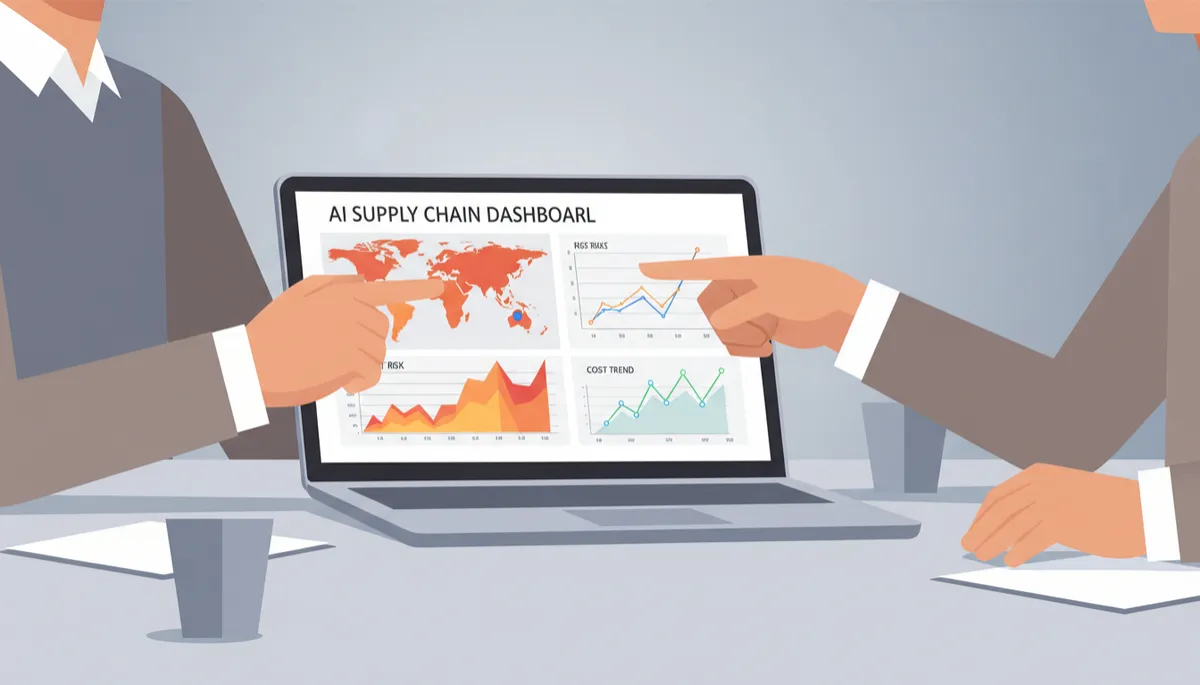
Unified AI dashboards turn scattered risk and cost data into clear, actionable priorities.
The Boardroom’s Role: Owning AI for Performance and Resilience
None of this happens at scale without the boardroom leaning in. AI for supply chain risk is no longer a “tools” decision buried three levels down—it is a performance and resilience decision that belongs squarely with the board and executive team.
Boards are already accountable for earnings stability, compliance, and enterprise risk. Supply chain shocks now show up directly in all three: missed revenue, margin compression, and reputational damage when customers or regulators are let down. That means directors need to be asking not just, “Do we have a risk register?” but, “Do we have AI‑enabled visibility and response capabilities that match our exposure?”
Set AI ambition and guardrails: Boards should define how aggressively the company will use AI in supply chain—where it can automate, where it should only recommend, and what ethical or compliance limits apply.
Link AI to performance metrics: AI investments should be tied to clear KPIs: service levels during disruption, working‑capital turns, logistics cost per unit, and recovery time from major events. These are board‑level numbers, not IT metrics.
Insist on data and talent foundations: Without clean data, cross‑functional ownership, and the right skills in planning and procurement, AI will underperform. Boards can push for a multi‑year roadmap, not just isolated pilots.
“In most sectors, the question for directors is no longer whether AI belongs in the supply chain. It’s whether the board is prepared to govern AI as a core lever of resilience and margin performance.”
— Independent Board Advisor, Global Manufacturing
📌 Boardroom Checklist for Tuesday: Ask to see one integrated view that connects AI‑identified risks to revenue, margin, and service impact—and the actions your teams are taking this week.
Why AI Support Is No Longer Optional
The core message for this Tuesday—and every planning cycle ahead—is straightforward: the pace and complexity of supply chain risk, disruption, and cost volatility have outgrown manual methods. AI is not about replacing human judgment; it is about giving supply chain teams a constantly updated, deeply informed view of what is happening and what might happen next.
As the AI in supply chain market grows rapidly, leaders who invest now in robust data foundations, clear governance, and practical use cases—like risk scanning, disruption response, and dynamic cost management—will be the ones turning volatility into competitive advantage. That investment must be championed and monitored from the boardroom, not just the control tower. The question is no longer whether you can afford AI in your supply chain. It’s whether you can afford to manage tomorrow’s risks without it—and whether your board is prepared to own that answer.