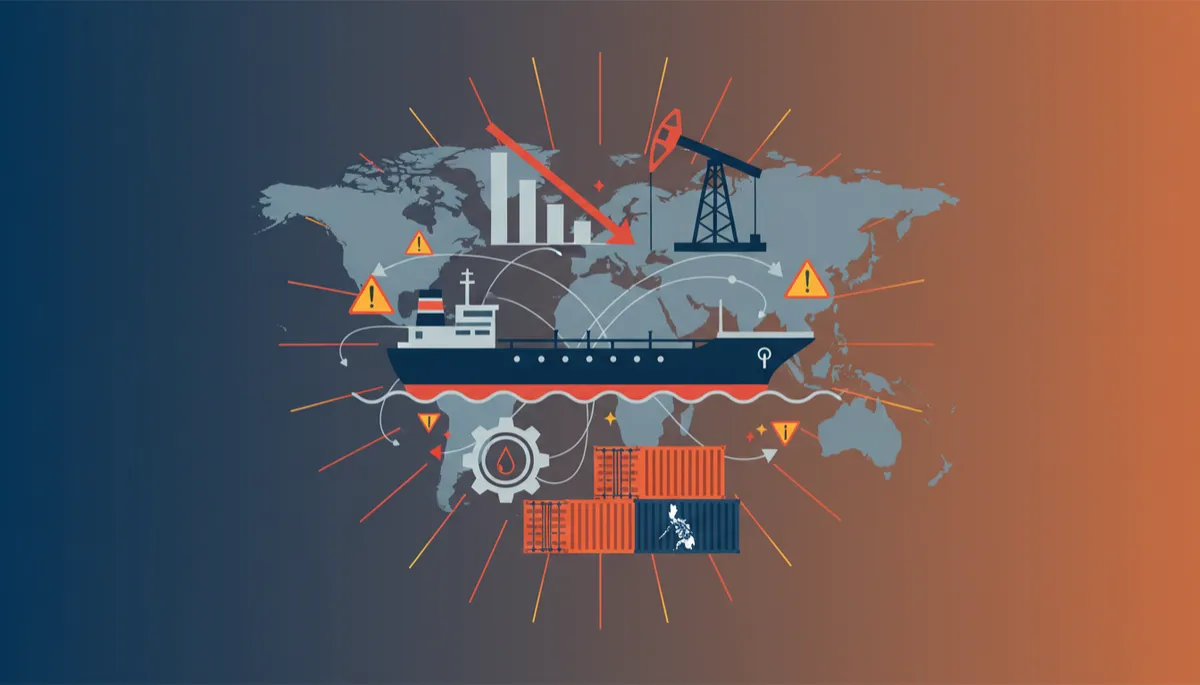
Global Oil & Transport Stress: Urgent Alert
Energy Markets, Transportation Logistics, Risk Management
Global Oil & Transportation Stress Watch: Material Alert | 14 October 2026
The IEA’s October 2026 Oil Market Report signals a materially stressed environment for fuel-dependent transport and logistics networks. For supply chain leaders, this is not a routine price cycle but a structural squeeze in diesel, inventories, and emergency buffers that demands immediate strategic action.
What the October 2026 IEA Oil Market Report Is Telling Supply Chains
The International Energy Agency’s October 2026 Oil Market Report (OMR) paints a picture of a market under sustained strain. Global oil demand is expected to fall by around 2.6 million barrels per day (mb/d) in 2026, with a modest 2 mb/d recovery in 2027 that still leaves consumption below 2025 levels (IEA). This is not a sign of comfortable balance, but of price-driven demand destruction in an environment of elevated geopolitical risk and tight product availability.
On the supply side, crude production rebounded month-on-month in September to 102.3 mb/d, largely on the back of Gulf producers. Yet annual supply for 2026 is still projected to average just 100.7 mb/d, nearly 6 mb/d below last year, before a tentative recovery in 2027. With North Sea Dated crude around $134/bbl and Brent futures near $107/bbl, fuel costs are already reshaping freight economics across modes. Then add 25%+ shipping cost!
Lagging Diesel Recovery and Measurable Demand Destruction
For transportation and logistics operators, diesel is the critical stress point. The IEA highlights that global diesel exports in September were 700 kb/d lower than a year earlier, driven by a 1.3 mb/d drop in flows from Russia and the Middle East. Despite a gradual rebound in refinery throughput toward year-end, the agency and independent analysts do not expect a meaningful diesel inventory rebuild before the second half of 2027.
This lagging supply recovery is already translating into demand destruction. The IEA estimates that diesel accounts for roughly 25% of the 2026 decline in global oil demand. High prices are forcing freight consolidations, modal shifts, and in some cases outright reductions in activity, particularly for lower-margin cargo and discretionary travel. Yet diesel demand remains relatively inelastic in core sectors such as agriculture, essential goods distribution, and public transport, amplifying cost pressure where activity cannot easily be curtailed.

Elevated diesel prices are forcing route redesigns, load optimization, and tighter service prioritization.
Eroding Emergency Buffers and Inventory Risk
The October OMR (IEA oil market report) also underscores a rapid erosion of global emergency buffers. Observed oil inventories fell by 10 million barrels in September, with on-land stocks drawing by 113 mb and only partial offset from oil held on water. Since end-February, global stocks are down roughly 509 mb, leaving both OECD and non-OECD buyers with far thinner cushions against disruption (IEA).
For fuel-intensive transport networks, this means that strategic and commercial stocks can no longer be assumed to absorb short-term shocks. Any further outage in the Middle East or Russia, or extended refinery downtime, could translate quickly into localized shortages, rationing, or extreme price spikes in key bunkering and trucking hubs. This becomes worse where there is oil Nationalism taking root creating even more pockets of constrained distribution drive localized price spikes, California as an example.
Regional Focus: Implications for the Philippines
The Philippines, considered as a bell weather of impact to consumers shows us how refined pricing and availability impacts the consumer directly, and not just in Philippines. As a net importer of refined products, Philippines is particularly exposed. Transport fuels are a major driver of domestic inflation, and historical analysis from the Bangko Sentral ng Pilipinas shows that oil price spikes quickly pass through to public transport fares, food prices, and logistics costs. With global diesel tightness likely to persist into 2027, Philippine shippers and carriers can expect:
Continued upward pressure on jeepney, bus, and inter-island shipping fares, even with periodic government subsidies.
Higher landed costs for imported goods, raising working capital needs across retail and manufacturing supply chains.
Intensified policy push toward electric vehicles and more efficient public transport, aligned with the Philippines Energy Plan 2020–2040.
For domestic logistics providers, this environment demands a sharper focus on fuel risk management, network design, and collaboration with customers on cost-sharing mechanisms.
Strategic Recommendations for Supply Chain and Transport Managers
In light of the IEA’s October 2026 findings, supply chain leaders should treat the current situation as a multi-year structural challenge rather than a short-lived spike. Key actions include:
Strengthen fuel risk governance. Establish cross-functional fuel risk committees, set clear thresholds for hedging, and regularly stress-test budgets against scenarios of sustained diesel prices above current levels.
Re-optimise networks for fuel efficiency. Consolidate loads, redesign routes to cut empty miles, and consider shifting appropriate flows to rail or coastal shipping where feasible, particularly in archipelagic markets like the Philippines.
Diversify energy and equipment portfolios. Accelerate pilots of electric and hybrid vehicles on urban routes, explore LNG or alternative fuels for select lanes, and prioritise high-efficiency assets in fleet renewal decisions.
Renegotiate contracts with transparent fuel mechanisms. Ensure freight contracts include clear, data-linked fuel adjustment clauses and service-level flexibility to accommodate route changes or mode shifts.
Coordinate with policymakers. In markets such as the Philippines, engage with government on targeted subsidies, strategic stock policy, and incentives for energy-efficient transport investments.
The October 2026 IEA Oil Market Report is a clear warning: diesel markets will remain tight, emergency buffers are eroding, and demand destruction is already reshaping transport activity. Organisations that respond with disciplined fuel risk management, structural efficiency improvements, and accelerated energy transition planning will be best positioned to maintain service reliability and protect margins through this period of global oil and transportation stress.
Read the entire weekly dashboard update here; https://drive.google.com/file/d/1uAxSAvJn90HbEqm76vZQ5s3iUt2B9fRh/view?usp=sharing