Global Oil & Transport Stress: Oct 11-12 Insights
Energy Markets, Global Oil Stress, Transportation Accessibility, Fuel Availability
Global Oil & Transportation Stress Watch: October 12 Reality
In just 24 hours between October 11 and 12, the focus shifted from analyzing potential vulnerabilities to confronting real‑time disruptions across global fuel and transport systems. As aviation outages deepen in Riyadh and the Philippines, fuel inventories and prices move in Manila, and Saudi Arabia advances new crude‑export and pipeline plans, the fragile balance between routes, reserves, and geopolitical risk is being tested on the ground.
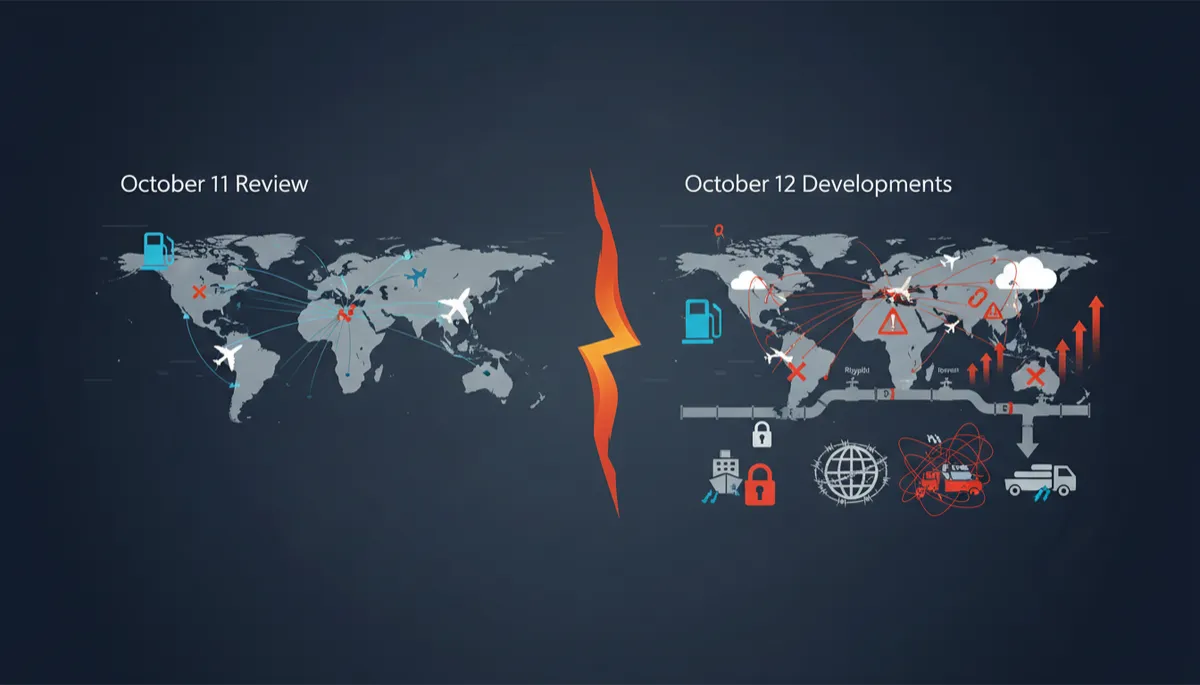
October 11 vs. October 12: A Rapid Escalation in Global Oil Stress
On October 11, much of the conversation around Global Oil Stress centered on structural imbalances: depleted inventories, elevated prices, and simmering geopolitical risks. Brent crude hovered above $102–$104 per barrel, supported by a tight diesel market and a fragile buffer of less than six billion barrels of commercially available stocks worldwide (EnergyGully; Investing.com). The tone was anxious but still analytical: a review of risks, not yet a catalogue of cascading failures.
By October 12, that review had turned into lived reality. The same forces that analysts had warned about—geopolitical flashpoints, tight fuel supply, and brittle logistics—crystallized into concrete disruptions. Airlines suspended routes, passengers were stranded, and governments scrambled to adjust fuel prices and secure new supply lines. The difference between the October 11 outlook and October 12 developments lies not just in new data, but in the way transportation networks suddenly felt the full weight of existing vulnerabilities.
📌 Key Takeaway: October 11 was about modeling risk; October 12 showed how quickly that risk can translate into grounded planes, rerouted ships, and higher prices at the pump.
Fuel Availability vs. Transportation Accessibility: A Widening Disconnect
One of the most striking themes emerging between October 11 and 12 is the growing mismatch between fuel availability on a global scale and local transportation accessibility. On paper, crude and refined products are still flowing. Around 20 million barrels per day are transiting the Strait of Hormuz, and Gulf exporters continue to ship oil despite security incidents (ICIS). Yet for travelers trying to fly between Riyadh and Manila, or for Filipino households watching fuel price boards, that theoretical availability feels distant.
The world is witnessing a paradox: Global Oil Stress is not purely about barrels in the ground or even barrels on the water. It is about whether those barrels can be refined, transported, insured, and delivered to the right place at the right time. In this context, fuel availability is a necessary but no longer sufficient condition for mobility. Security threats, damaged infrastructure, and regulatory barriers can sever the link between supply and real-world transportation accessibility, leaving planes grounded even when fuel tanks are technically not empty.
Riyadh and the Philippines: Aviation Disruptions as a Frontline Indicator
Nowhere is this disconnect clearer than in the critical aviation disruptions in Riyadh and the Philippines. In early October, King Khalid International Airport in Riyadh became the target of a series of Houthi missile and drone attacks, leading to at least 12 deaths and more than 300 injuries, and forcing authorities to halt operations and divert or cancel flights (AP News). By October 11, more than 650 flights had been disrupted, affecting carriers far beyond the immediate region (The National).
For the Philippines, the impact has been particularly acute. Philippine Airlines (PAL) suspended its Riyadh–Manila services (PR654 and PR655) starting October 8 and, as of October 12, extended the suspension all the way through November 29, 2026, citing the evolving security situation in Riyadh (Philippine Airlines). Several Filipino nationals were among the wounded in the attacks, underscoring the human cost behind what might otherwise be seen as an abstract “aviation disruption.”
Low‑cost carrier Cebu Pacific also canceled multiple Manila–Riyadh flights—5J 740 and 5J 741—on dates spanning October 9 to 13, with further adjustments possible as conditions evolve (GMA Network). Meanwhile, new entrant Riyadh Air, which had planned to ramp up Riyadh–Manila frequencies to daily service from mid‑October, now faces uncertainty over whether that expansion can proceed as scheduled (Philstar).
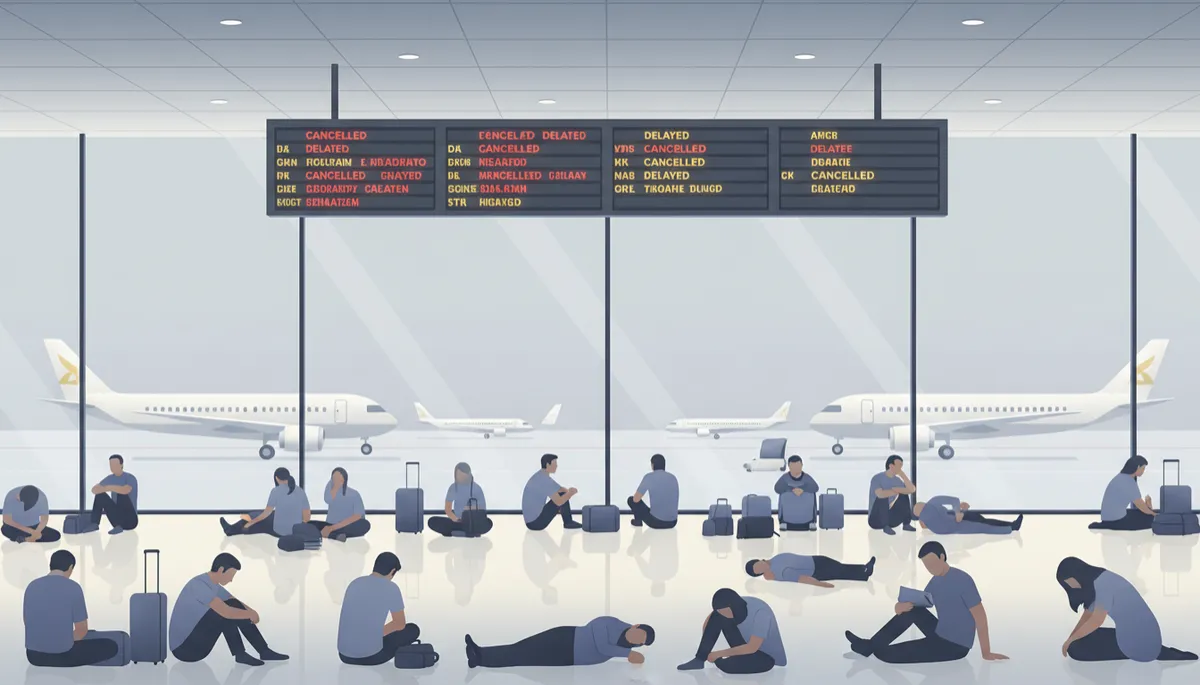
When routes shut down, oil in storage offers little comfort to grounded travelers.
Philippine Fuel Inventories and Price Adjustments: Managing Stress at Home
While flights are being canceled abroad, the Philippines is also contending with shifting fuel availability and prices at home. Local refiners and importers are navigating a world of high Brent prices, tight diesel supplies, and volatile freight costs. As global inventories have been drawn down at an average pace of 2.8 million barrels per day in recent months (IEA), the Philippines—like many import‑dependent economies—has limited flexibility to absorb new shocks without passing them on to consumers.
Updated fuel inventory data in October shows that while the country has secured short‑term supplies, buffers remain thin. This is especially true for diesel and other middle distillates, which have seen global crack spreads spike to record levels (EnergyGully). In response, local oil companies have implemented price adjustments that reflect both higher import costs and increased risk premiums on shipping routes. Motorists and logistics firms are facing steeper pump prices, even as some routes—like Manila–Riyadh—are being cut altogether.
This combination illustrates the core challenge of today’s Global Oil Stress: a country may have enough fuel in storage to keep trucks and domestic flights running, yet still see its international transportation accessibility deteriorate due to security risks, airline decisions, and external policy moves. For overseas Filipino workers who rely on the Riyadh–Manila corridor, the issue is not the presence of jet fuel in regional tanks—it is the absence of safe, operational routes.
💡 Pro Tip for Businesses: Treat fuel price forecasts and route reliability as a single, integrated risk—hedging one without planning for the other leaves a dangerous gap in resilience.
Saudi Crude-Export Arrangements and Pipeline Expansion Plans
Against this backdrop of aviation disruption and local price strain, Saudi Arabia is pressing ahead with efforts to stabilize its role as a cornerstone supplier. Current crude‑export arrangements are being recalibrated to balance long‑term contracts with Asian buyers, spot sales to Europe, and opportunistic shipments to markets scrambling for diesel and jet fuel substitutes. The goal is to maintain market share while navigating sanctions, security risks, and shifting alliances in a multipolar energy landscape.
Central to this strategy are pipeline expansion plans designed to reduce reliance on vulnerable sea lanes such as the Strait of Hormuz. Bypass pipelines and new overland routes are part of a broader regional effort, supported by forecasts from the U.S. Energy Information Administration that anticipate a gradual easing of market tightness by mid‑2027 as new infrastructure comes online (EIA). For Saudi Arabia, expanding pipelines that connect production fields to Red Sea terminals and neighboring countries offers both commercial and strategic advantages: fewer chokepoints, more flexibility in directing flows, and greater leverage in negotiations with buyers.
Yet these initiatives also highlight a crucial nuance in the current crisis. Even as Saudi Arabia invests in new routes to secure and expand crude exports, transport networks at the consumer end—airports, seaports, and road corridors—remain exposed to localized disruptions. Pipeline projects may help ease aggregate Global Oil Stress over the coming years, but they do not automatically restore canceled flights or repair damaged runways. Once again, supply and accessibility are diverging.
Emerging Supply-Chain Challenges: From Refineries to Runways
The events of October 11–12 reveal a web of emerging supply‑chain challenges that connect oil wells, pipelines, refineries, and end‑user transport systems. At the upstream and midstream levels, producers face refinery outages, sanctions‑driven re‑routing, and insurance complications for tankers passing through high‑risk zones. Refined products may be stranded in one region while shortages intensify in another, not because of a lack of molecules, but because of logistical knots and regulatory barriers.
Downstream, airlines and shipping companies must manage erratic delivery schedules, fluctuating bunker fuel costs, and last‑minute route closures. The Riyadh airport attacks are a dramatic example, but the same vulnerabilities play out in subtler ways across global trade: a delayed tanker here, a congested port there, a sudden export ban on a key fuel component somewhere else. Each small disruption adds friction to the system, eroding the reliability of transportation networks even when overall fuel availability appears stable on spreadsheets.
Geopolitical Restrictions: When Politics Override Logistics
Overlaying these logistical challenges are a host of geopolitical restrictions that further complicate the picture. Sanctions, export controls, and regional conflicts shape who can buy, sell, or transport oil and refined products. The ongoing tensions around Iran and the broader Middle East, including Houthi activity that threatens shipping and aviation, have injected a persistent risk premium into prices and undermined confidence in critical corridors like Hormuz (ICIS).
Policy responses can also have unintended consequences. Coordinated stock releases by IEA member countries—amounting to roughly 325 million barrels so far—were designed to soften the blow of supply shortfalls (ICIS). Yet these moves have left strategic reserves, particularly in the U.S., at their lowest levels in decades, reducing the capacity to respond to future shocks. Meanwhile, bilateral deals such as the U.S.–Russia diesel agreement are constrained by logistical bottlenecks and political backlash, limiting their ability to materially improve either fuel availability or transportation accessibility in the near term.
Ongoing Risks to Transportation Networks: What October 12 Signals About the Future
The disruptions seen on October 12 should be understood not as isolated incidents, but as signals of ongoing risks to transportation networks worldwide. Aviation, in particular, is exposed on multiple fronts: reliance on a narrow set of hub airports, sensitivity to jet fuel price spikes, and vulnerability to targeted attacks or cyber incidents. When a major node like Riyadh is forced offline, ripple effects spread across carrier schedules, cargo flows, and passenger itineraries from the Gulf to Southeast Asia and beyond.
Maritime and land‑based transport face similar hazards. Tanker routes through contested waters, cross‑border pipelines subject to diplomatic disputes, and rail lines dependent on stable power supplies all sit at the intersection of energy security and geopolitical risk. For businesses and governments, the lesson from the October 11–12 window is clear: planning for Global Oil Stress must extend beyond questions of price and volume to include a detailed understanding of how shocks propagate through real‑world mobility systems.
📌 Key Takeaway: Fuel in storage, pipelines in place, and ships at sea do not guarantee movement; the true test of resilience is whether people and goods can still reach where they need to go.
Bridging the Gap: Aligning Fuel Availability with Transportation Accessibility
Looking ahead, the challenge for policymakers, energy companies, and transport operators is to narrow the widening gap between fuel availability and transportation accessibility. That means investing not only in supply—through projects like Saudi Arabia’s pipeline expansion—but also in the resilience of airports, seaports, and logistics chains that depend on that supply. It requires better coordination between energy planners and transportation authorities, so that decisions about stockpiles, export policies, and route security are made with a shared understanding of their downstream mobility impacts.
For countries like the Philippines, strengthening domestic fuel storage, diversifying import sources, and improving transparency around inventory and price adjustments can help cushion households and businesses from external shocks. At the same time, building redundancy into critical air and sea routes—through alternative hubs, flexible scheduling, and contingency agreements—can reduce the risk that a single airport closure or regional crisis will sever vital links for workers, tourists, and trade.
The events between October 11 and 12 have made one thing unmistakably clear: Global Oil Stress is no longer a distant macroeconomic concern. It is a lived reality at boarding gates, fuel depots, and shipping terminals around the world. Bridging the divide between fuel in tanks and mobility on the ground will define how effectively the world navigates the turbulent energy landscape of the late 2020s—and how quickly it can move from crisis response to long‑term stability.
Download the full dashboard update for Oct 12 here; https://drive.google.com/file/d/1d2OREWZfU2sR6kJ5Y_DkOe7Bc5_hZgy5/view?usp=sharing