Long-Term Supply Chain Strategies Post Oil Shock
Supply Chain Strategy, Energy Risk, Executive Outlook
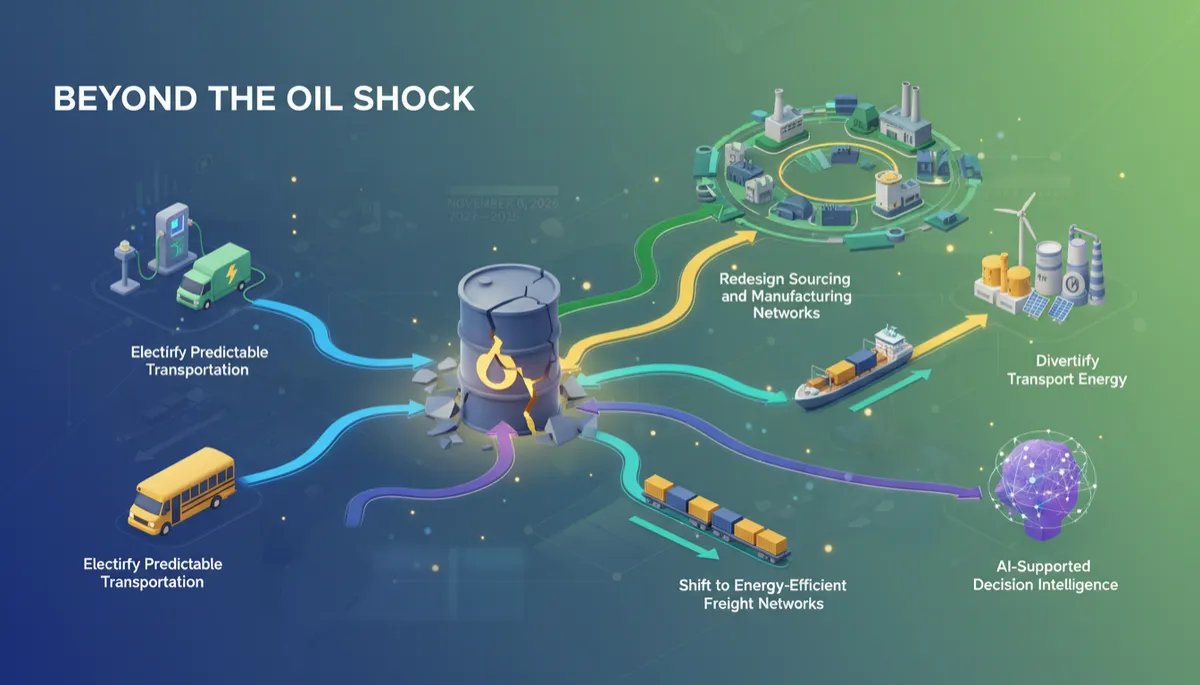
Beyond the Oil Shock: Five Long-Term Alternatives for Supply Chain Leaders (2027–2035)
Strategic Outlook: November 8, 2026 | Planning Horizon: 2027–2035
With U.S. diesel still near $6.30 per gallon and gasoline around $4.15 as of early November 2026, the question for supply chain leaders is no longer how to ride out this spike. It is how to design supply chains so that the next fuel shock—whether driven by geopolitics, refinery outages or trade policy—has less power to interrupt operations, erode margins or damage service. Crude supply, refined-product availability, trade rules and transport economics must now be managed as distinct, overlapping risks, not a single “fuel-price problem.”
Five Long-Term Alternatives for Energy-Resilient Supply Chains
Leading organizations are shifting from short-term cost containment to a portfolio of structural moves. The most promising long-term alternatives are:
Electrify predictable transportation where routes and charging windows are stable.
Redesign sourcing and manufacturing networks for selective regionalization and redundancy.
Reduce transportation energy before changing fuels through freight efficiency and mode shifts.
Diversify fuels without assuming one winner, matching options to use cases and constraints.
Build AI-supported decision intelligence that links external energy signals to internal exposures.
📌 Key Executive Principle: Prioritize network and operational improvements that work under multiple energy scenarios before making large, irreversible technology bets.
1. Electrify Predictable Transportation First
Not every fleet is ready for electrification, but some segments already are. The strongest candidates are urban delivery, depot-based trucks, school buses, municipal fleets, port drayage and fixed-route passenger services. These operations typically have known daily distances, defined dwell times and consistent return-to-base behavior—ideal conditions for overnight or opportunity charging.
Segment fleets by daily distance, payload, dwell time and return-to-base patterns rather than by vehicle class alone.
Model a seven-year total cost of ownership, including vehicles, chargers, electricity demand charges, maintenance, financing, insurance, downtime and residual value.
For outsourced fleets, require carriers to disclose diesel exposure and present credible transition plans tied to your service and cost objectives.
In markets such as Philippine jeepneys and other owner-operator systems, economics are highly route-specific. Before recommending conversion, evaluate operator financing capacity, route demand, charging access and actual fare economics. KPIs should include energy cost per kilometer, diesel displaced, availability, charger uptime, seven-year NPV and cost per delivered unit.
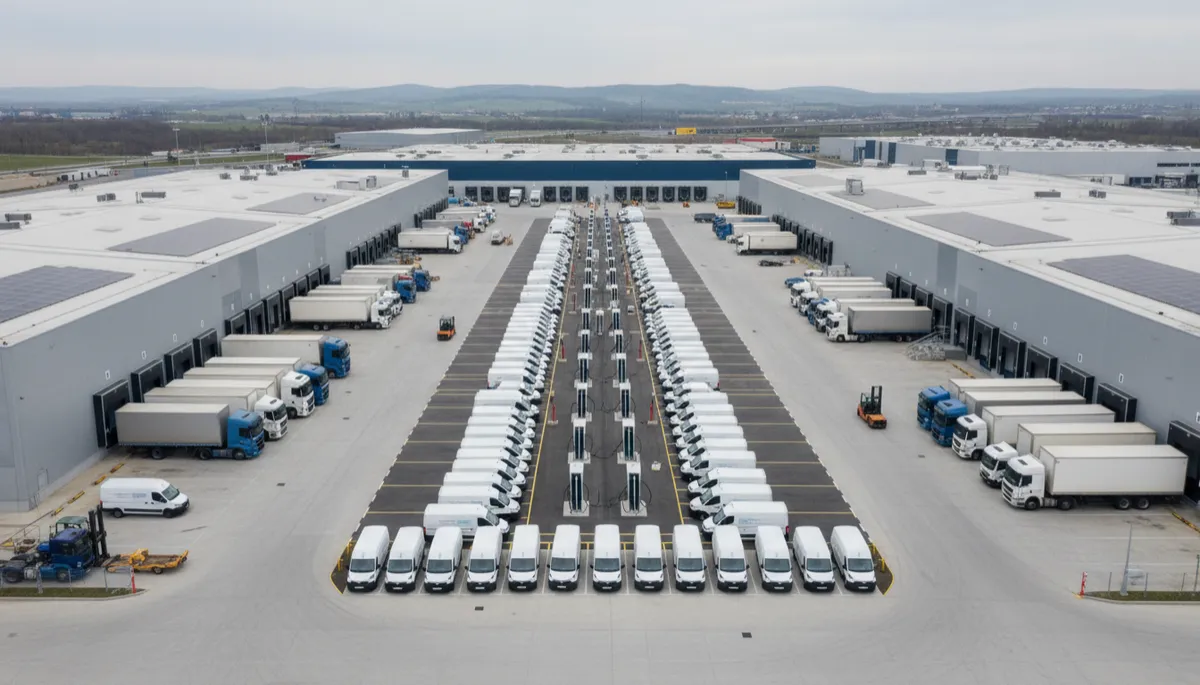
Depot-based electrification lets leaders cut diesel exposure without disrupting long-haul networks.
2. Redesign Sourcing and Manufacturing Networks
The goal is selective regionalization and operational redundancy, not blanket reshoring. For many categories, the right answer is a competitive Asian primary supplier plus a qualified regional backup, with final customization moved closer to demand. This reduces exposure to long, fuel-intensive corridors and policy shocks while preserving scale advantages where they matter most.
Network option | Most useful when | Principal trade-off |
|---|---|---|
Regional production | Stable volume and high freight exposure | Higher capital and unit costs |
Dual-region sourcing | High-consequence supply concentration | Qualification effort and reduced scale leverage |
Postponement | High variety and uncertain product mix | Requires modular design and disciplined execution |
Use a decision rule that compares landed cost plus probability‑weighted disruption losses—including expedited freight, lost contribution margin and recovery costs. Avoid treating uncertain probabilities as precise facts. KPIs should track time to recover, dual-sourcing coverage for critical components, concentration by country and route, and contribution margin under disruption scenarios.
3. Reduce Transportation Energy Before Changing Fuels
Energy-efficient freight networks are often faster and cheaper to deploy than new propulsion technologies. Start by improving how you use existing assets: higher trailer utilization, fewer empty miles, smarter delivery windows and fewer avoidable expedites. Only then consider truck-to-rail or intermodal shifts where transit-time and service commitments allow.
0–12 months: consolidate shipments, optimize routes and backhauls, cut empty mileage.
1–3 years: redesign modes, shipment frequencies and distribution-center allocation.
3–7 years: locate manufacturing and inventory along resilient demand and intermodal corridors.
💡 Pro Tip: A 7% reduction on a $20 million freight budget is $1.4 million in annual savings. That is arithmetic, not a forecast—use it as a benchmark for business-case discipline, not a promise.
KPIs include freight cost per unit, energy per ton‑kilometer, load factor, empty miles, on‑time delivery and inventory days. When considering ocean substitution for air, incorporate pipeline inventory, obsolescence risk and service impacts—not just freight rates.
4. Diversify Fuels Without Assuming One Winner
By 2026, alternative fuels—from renewable diesel and sustainable aviation fuel (SAF) to methanol and hydrogen—are expanding, but none is a universal solution. The right choice depends on mode, route economics, infrastructure and lifecycle impacts. For example, renewable diesel can be a bridge fuel for compatible fleets, while SAF is critical for aviation but constrained by cost and supply. Hydrogen may be viable for specific heavy-duty or industrial applications, not as a near-term default everywhere.
Mode | Promising option | Critical constraint |
|---|---|---|
Urban delivery / school buses | Battery electric | Grid connection, charging, capital cost |
Regional trucking | Battery electric or renewable diesel | Route economics, fuel availability |
Aviation | SAF and network efficiency | Supply, price, feedstocks |
Alternative fuels can also introduce new concentration risks in feedstocks, batteries and bunkering locations. Track lifecycle cost, supply diversity, energy intensity, emissions under a consistent accounting method and fuel-service availability. The objective is an option-rich portfolio, not a bet on a single technological winner.
5. Build AI-Supported Decision Intelligence
Finally, energy resilience is a decision problem as much as an engineering one. Many companies still rely on dashboards that describe what happened last month. The next step is AI-supported decision intelligence that links external signals—fuel prices, inventories, export controls, freight capacity, inflation—to internal exposures such as suppliers, bills of material, transport lanes, carrier contracts, customer profitability and inventory policies.
A practical decision flow is: external signals → exposure model → scenario and cost‑to‑serve engine → procurement, logistics and S&OP decisions. AI can support anomaly detection, scenario ranking and recommendation generation; human managers should still approve material decisions, especially when data are incomplete or assumptions are contested. Executive KPIs include energy‑adjusted cost to serve, revenue at risk, time to recover, transportation dependency and decision response time.
From Cheaper Oil to Smarter Supply Chains
An illustrative allocation of strategic attention over the 2027–2035 horizon might be: network redesign (30%), freight efficiency (25%), decision intelligence (20%), fleet electrification (15%) and alternative fuels (10%). These are guidance for management focus, not mandated capital budgets. Network and freight decisions rank highest because their benefits endure regardless of which energy technology ultimately dominates.
The next competitive advantage will not be guessing the exact path of oil prices. It will be building a supply chain that requires less fuel per unit of value, offers multiple sourcing and transportation options, and can pivot faster than competitors when conditions change. Leaders who act now—electrifying the right routes, redesigning networks, squeezing out wasted energy, diversifying fuels and investing in AI-supported decisions—will be better positioned for whatever the 2027–2035 energy landscape delivers.
For the full report use this link; https://drive.google.com/file/d/1chg6DoL0ULnyd8xOZfsvVOIkTOst8Flh/view?usp=drive_link